If you're one of the 40 million American women experiencing hair thinning — you've probably already tried biotin, collagen supplements, scalp serums, and maybe even a visit or two to a dermatologist.
And you've probably been told some variation of the same thing: it's hormones. It's stress. It's aging. Take this supplement. Be patient.
But here's what the hair loss industry hasn't told you — and what new research is making impossible to ignore:
The reason most hair loss treatments fail for women over 40 is not that they're using the wrong product. It's that they're targeting the wrong mechanism entirely.
The Hidden Epidemic on Your Scalp
Ask yourself three quick questions.
Does your scalp sometimes feel tight, sensitive, or oddly tender — especially where your hair is thinnest?
Do you notice more shedding after periods of stress, illness, or hormonal shifts — even short ones?
Have you used biotin, collagen, or other hair supplements for months and seen only modest results at best?
If you answered yes to any of those, what you're about to read may explain everything you've been wondering.
There is a condition researchers now call perifollicular microinflammation. It's not the dramatic, visible inflammation of an injury. You can't see it or feel it acutely. But under a microscope, it's doing something devastating.
It's wrapping each hair follicle in a thin layer of fibrotic tissue. Like shrink-wrap around a straw — gradually cutting off the oxygen and nutrient supply that each follicle needs to produce a strong, healthy hair shaft.
"We've spent decades focused on DHT and estrogen while ignoring what was happening at the follicle wall itself. The fibrotic tissue that forms around miniaturizing follicles is the real strangler. Address that, and suddenly treatments that weren't working start to work."
Why Your Current Treatments Aren't Working
This single finding explains the frustrating mystery that millions of women have experienced: why some treatments seem to help a little, then plateau. Why a good month of reduced shedding is followed by another bout of heavy loss. Why your hair never quite gets back to where it was.
Here's what the most popular approaches actually do — and what they miss:
- Biotin: Addresses a potential deficiency, but deficiency is rare in adults eating a normal diet. Does nothing for follicle inflammation or restricted circulation.
- Collagen supplements: Support skin elasticity broadly. Don't penetrate to the follicle itself. No mechanism to address fibrotic restriction.
- DHT-blocking treatments (Rogaine, Viviscal, etc.): Work for the subset of women whose hair loss is purely DHT-driven. Fail entirely when inflammation is the primary driver — even if DHT is also present.
- Scalp serums and topicals: Typically address surface dryness or circulation in the superficial dermis. Rarely formulated to reach the deeper perifollicular layer where fibrosis forms.
- Stress and hormonal management: Important, but downstream. Hormonal shifts trigger inflammation — fixing the trigger doesn't fix the damage already done to follicles.
In short: if you haven't addressed the underlying inflammatory cascade, no amount of growth stimulation will work at full capacity. You're trying to regrow a garden in soil that's still being poisoned.
The Three-Compound Discovery
While developing a hemp-derived extract for systemic inflammation reduction, researchers at a botanical research laboratory made an unexpected observation. When the water-soluble hemp compound — now patented as Kannopia-Active — was applied at the scalp in combination with two specific co-factors, something remarkable happened to the perifollicular tissue.
The fibrotic restriction didn't just stop progressing. It began to reverse.
The key was the three-compound combination. Kannopia-Active alone reduced inflammation markers. But paired with a high-potency antioxidant (Astaxanthin) and a follicle-regulating mineral (Boron), the effect was amplified significantly — because each compound addresses a different stage of the same destructive process.
How The Three Compounds Work Together
The power isn't in any single ingredient. It's in the sequence — each compound addressing a different stage of the same chain reaction that kills follicles:
Neutralise the oxidative trigger
Astaxanthin intercepts the free radical damage that signals the scalp's immune system to begin the inflammatory response.
Calm the inflammatory cascade
Kannopia-Active reduces the inflammatory signalling compounds (including TGF-β1) that trigger perifollicular fibrosis.
Restore follicle circulation
As fibrotic restriction eases, oxygen and nutrient delivery to follicles improves — sometimes for the first time in years.
Regulate the hair cycle
Boron supports the follicle's ability to enter and sustain the anagen (growth) phase rather than cycling prematurely into shedding.
Rebuild from the inside out
With the inflammatory environment resolved, follicles that were miniaturising — but not yet permanently scarred — can begin to recover.
What Women Are Reporting
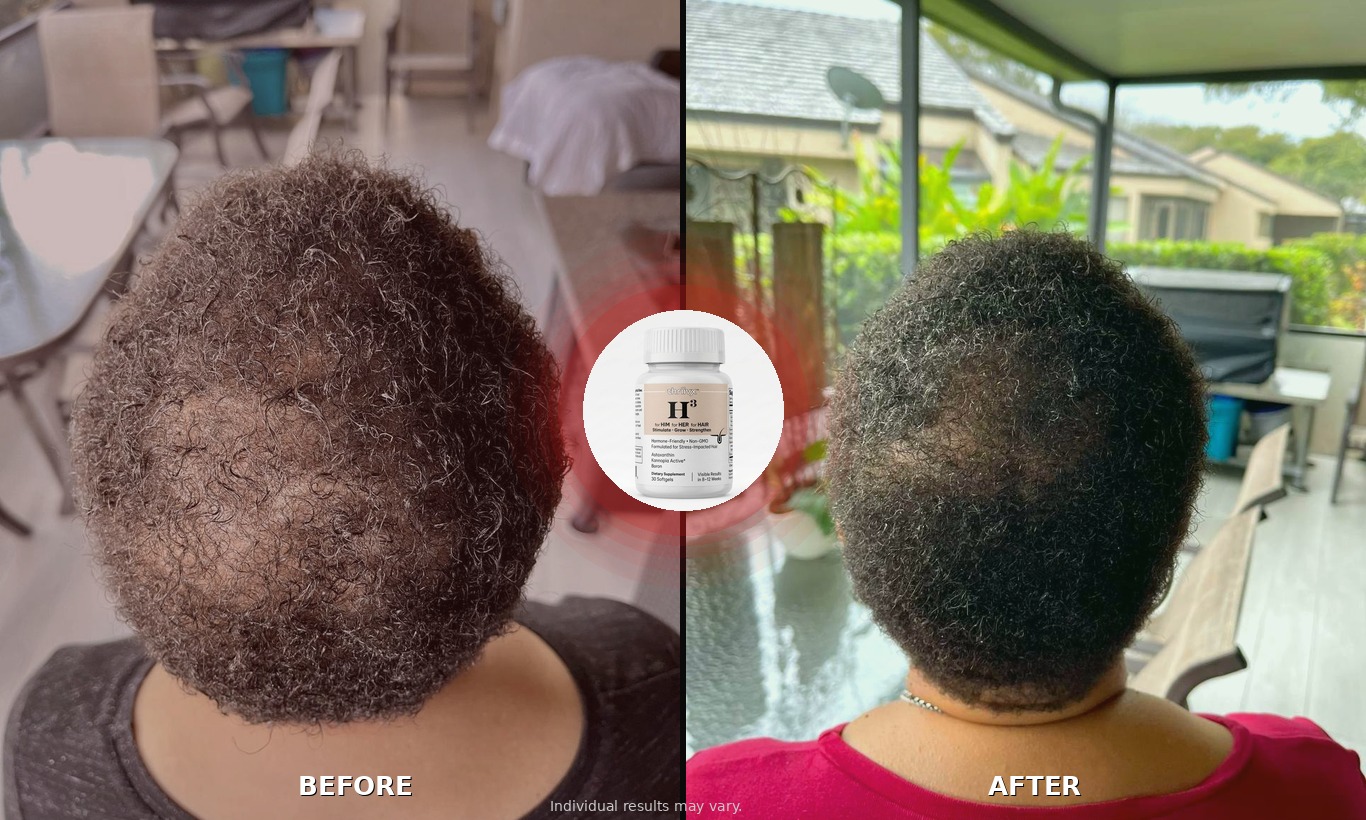
"I'd taken biotin every single day for two years. My hair just kept getting thinner at the crown. Within three weeks of starting H3 I noticed the shedding had slowed dramatically. By week eight I had visible regrowth in areas that had been thinning for years. I genuinely thought that ship had sailed."
"My hair started going in my early forties and I assumed it was menopause-related. Hormonal supplements helped a bit, then stopped. What I didn't know was that I had significant scalp inflammation — my trichologist confirmed it. H3 was the first thing that addressed that directly."
"I was sceptical — I've spent a small fortune on hair supplements. But the science behind this was genuinely different. After ten weeks I had more baby hairs at my hairline than I'd seen in a decade. My husband noticed before I mentioned it to him."
Why You're Only Hearing About This Now
If this research is compelling, why isn't every hair loss specialist talking about it?
The answer is straightforward, if frustrating.
Pharmaceutical companies can't easily patent natural compounds like hemp extracts, astaxanthin, or boron. The financial incentive to develop, test, and market them — at the scale required to shift mainstream clinical practice — simply doesn't exist the way it does for patentable drugs.
Meanwhile, a $4.2 billion industry built on DHT-focused solutions continues to dominate dermatology conversations, even as the evidence for inflammation as a co-driver (and sometimes primary driver) of hair loss quietly accumulates in research journals.
This protocol has been spreading through integrative medicine circles and forward-thinking trichology practices — but it has not yet reached the mainstream.
Follicles that have been inflamed for extended periods eventually undergo permanent fibrosis — the surrounding tissue becomes so scarred that even transplants struggle to take. Every month of ongoing inflammation is another month of follicles moving closer to that threshold. The research is clear: address the inflammation while follicles are still viable, and recovery is possible. Wait until permanent fibrosis has set in, and no supplement — including this one — can reverse that.
International Trichology Association, 2024 — 12 Studies, 2,814 Participants: "Controlling perifollicular inflammation should be considered a primary — not adjunct — intervention in female pattern hair loss. Current evidence indicates it is a driver in the majority of cases, independent of hormonal status." Yet the majority of women presenting with hair loss are still not being assessed for scalp inflammation levels.
How To Expect It To Work
Based on clinical observations and user reporting, here is the typical progression for women starting the H3 protocol:
H3 vs Traditional Hair Loss Approaches
| What it does | Biotin / Collagen | Minoxidil / DHT blockers | ThriivX H3 |
|---|---|---|---|
| Targets perifollicular inflammation | ✗ | ✗ | ✓ |
| Neutralises oxidative stress trigger | ✗ | ✗ | ✓ |
| Supports follicle biology directly | ✗ | Partially | ✓ |
| Works without drugs or hormones | ✓ | ✗ | ✓ |
| No dependency or withdrawal effect | ✓ | ✗ | ✓ |
The Bottom Line
For decades, women over 40 have been told their hair loss is inevitable. That it's hormones. That aging is the culprit. That the best they can hope for is slowing the decline.
The research is telling a different story.
Yes, hormones play a role. Yes, genetics load the gun. But in the majority of women experiencing hair thinning — the inflammatory cascade is what actually pulls the trigger. And it's been going untreated, because the tools to address it haven't existed in a practical, accessible form until now.
The only question is whether you address it now — while your follicles are still viable — or wait.


